Showing posts with label behind the scenes. Show all posts

Friday, January 11, 2013

Comics Bulletin Interview!

 
Jason Sacks of Comics Bulletin sat down with Frank and I at Ballard Coffee Works in Seattle for one of our most enjoyable interviews... 
http://comicsbulletin.com/interviews/5295/frank-young-and-david-lasky-dont-forget-the-carter-family/

Among other things, we reveal that there is a tribute to Action Comics #1 hidden in "Carter Family: Don't Forget This Song"...


Sunday, October 28, 2012

Sunday in Tallahassee

Frank Young's hometown newspaper, the Tallahassee Democrat, features us on the cover of their Sunday magazine today!


Read the Q&A with Frank here...

Monday, October 15, 2012

Comics Reporter Interview with Frank Young and David Lasky

It was a pleasure to be interviewed by my old friend Tom Spurgeon, who happens to put together the coolest comics news site on the Internet, Comics Reporter.  He asked Frank and I about certain pages in the book, as way of exploring wider issues, and our working process.  Read the interview here...


Tuesday, September 25, 2012

"Single Girl" Page Evolution

I think I first heard "Single Girl, Married Girl" on Harry Smith's landmark Anthology of American Folk Music.  I'd never heard a song like it, or a voice like Sara Carter's.  It planted the seeds of my interest in the Carter Family, and in my collaboration with Frank Young on the graphic novel.  So the page in which Sara and Maybelle record the song was very important to me. I think of it as the cornerstone of the book. 

Originally I had a vision of the moment as Sara and Maybelle performing in empty space, with no panel borders, as an expression of the haunting quality of the song...


The sequence went on for several panels and covered a good bit of the song. When Frank and I learned that the Carter Family's lyrics were largely not in the public domain, we had to change plans!  Frank came up with the large single panel you see at the bottom of the page:

 
It didn't feel quite right to me, for such a momentous moment.  I tried it as a closeup:


This wasn't working for me either. I wanted a 1930's comic strip look, but this panel felt more like a 1960's DC comic book. I stopped right in the middle of inking and decided I had to pull the view back. But I liked the idea of the words being words and word balloons at the same time, and I kept that concept...
 
 
I was very happy with this result!  But it took a little longer than most of the other pages in the book. 
 
One side note: Quilts were hung on the walls of the makeshift studio to muffle outside sounds. All the quilts I drew were researched for accuracy...


Monday, September 24, 2012

My Research Trip

Ten years ago, in the fall of 2002, my father and I drove from Alexandria, VA, down to Bristol VA/TN (it's right on the border).  It was something like nine hours of driving, across the state of Virginia.  It proved to be one of the best road trips I've ever taken. 


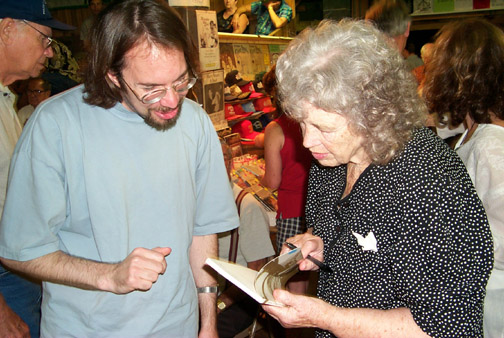
We went to the Carter Family Fold, saw and heard a great concert, and I had Janette Carter autograph a copy of her memoir, "Living with Memories."  (Thanks John Maeder, for taking this photo.)

 Near the CFF, there was a small (but concentrated) Carter Family museum, housed in the building that was once A.P. Carter's store.  We also made it to the church where the Carters' worshipped, and where A.P., Sara, and many other family members are buried.  I wanted to make comics about the Carter Family, because I had wondered where this beautiful, heartfelt music had come from, and who had made it.  It was very exciting to be in the place where they lived and worked.  I took photos.

We also visited the Birthplace of Country Music Alliance, whose museum was in the Bristol shopping mall at that time.  I'm excited to see that they are working on a Cultural Heritage Center. 
http://www.birthplaceofcountrymusic.org/

Thanks, Dad, for taking me down to Maces Spring and Bristol!

Thursday, September 13, 2012

The Evolution of a "Carter Family: Don't Forget This Song" Page

Frank and I wanted to show you what went into creating an average page of our Carter Family graphic novel. I chose the page in which their producer and manager, Ralph Peer, along with his wife Anita, arrives on a visit to the Carters in Maces Spring, VA. 
The text here, is by Frank, unless I pipe in (with blue type)...
-David

The process of creating comics is highly subjective. Some artists just put pen or pencil to paper and move forward, without a clear idea where they're going. Others out-do Alfred Hitchcock in the pre-planning stages, and create multiple images of each panel before they commit the final image to paper.

Add a writer to the mix, and their style of input also affects the creative outcome.

Every cartoonist or creative team has their own method. And a method of some kind is a must--especially when creating a long-form work. Our agent, Bob Mecoy, has called our graphic novel a "movie on paper," and some of the methodology of film-making did influence our approach.

Here is the origin of one page from our book, from rough script to thumbnails to pencil and ink to publication.

The script, at this point, is more of a guidepost of the marks we want to hit in each panel. There's no for-real dialogue--just detailed descriptions of each panel's event, mood and what each character is doing or feeling. Nothing is cast in stone here. In this case, the finished page is pretty close to the descriptions in the script.

The only piece of dialogue that stayed to the end is A.P.'s blessing for the meal, in the last panel of the page. That was a documented piece of real-life speech.

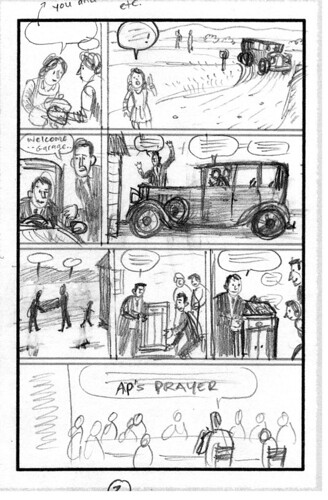
Next is the first rough thumbnail. This is a vital stage. Will the sequence work in comics form? Does the panel-to-panel flow make sense, and support the events and the characters? Frank did this first thumbnail. It won't win an art contest; it's only meant to serve the material.
(Note: The 'thumbnail' images are only about 3 inches tall. Just enough to get a sense of what will fit on the page, without getting bogged down in details.)


Next, David took this first rough thumbnail and revised it. Notice that he cuts out a panel and adds another. This was a good decision. His sketches are tighter than the first thumbnail, but still more suggestive than definitive.

(We wanted to highlight the fact that the Ralph Peer's Cadillac is large -- too large for the garage A.P. has built in anticipation of the visit. We've also added a panel to the presentation of the Orthophonic Credenza, an important gift from Peer to the Carters.)

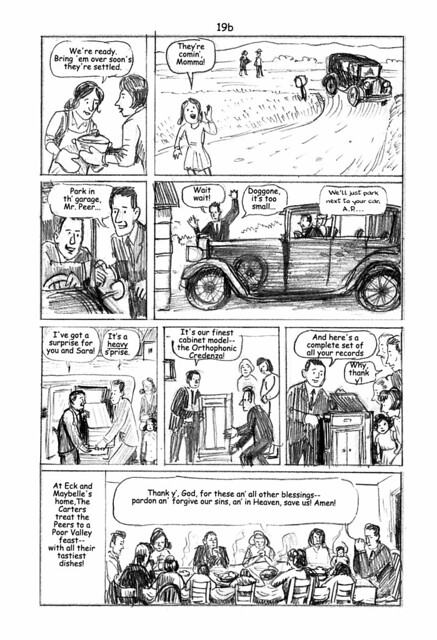
In the next iteration, (a pencil rough drawn at print size) David tightens up the staging of the panels, the body language of each character, and gives a strong sense of the settings. Frank then enters the first draft of the dialogue.


Then, it's decided that a long-shot could be made more effective as a medium shot (in panel 5). At this point, the page is ready to commit to ink on paper.

(We showed the rough draft of our book to an artist who is very experienced with this kind of material, and he advised me to draw Ralph Peer's Cadillac Limo much larger. On this page I digitally enlarged the Cadillac in every panel, and made Peer higher in the driver's seat, in panel 3. We also decided to add more family members to the table in the last panel.)

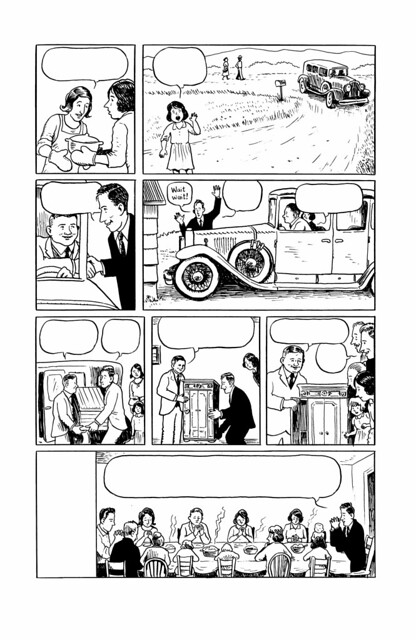
As David inks the final version, he tightens up the compositions and figures. This piece of the story really and truly comes to life.

(I should note that we had to find reference photos for the Cadillac Limo and the Orthophonic Credenza. Extra time, but worth it for historical accuracy.)


Now it's ready for Frank to color. After that, the final dialogue is written. There are some small changes from the first draft of the dialogue and narration--mostly in reducing the amount of text.

As said, this page did not undergo a major change from start to finish--just a refinement of the narrative event that its eight panels capture.

(I hope what comes across is that a great amount of care went into making every page of this book. Frank and I gave this our all.)

If anyone would like to see larger versions of the images above, they are all available on flickr.com: http://www.flickr.com/photos/dlasky/tags/dftspageevolution/

Sunday, September 28, 2008

From Words To Pictures: The Process Begins


I thought I'd lead off today's post with this stunning detail from a piece of art David did for our book proposal. I think it helped seal the deal. David's sense of humanity in his figures always moves and impresses me. His figures--and even his landscapes--have that breath of life to them; that something extra that creates an instant engagement with the observer.

I'm braggin' on you, David.

We spent the last workweek breaking down our outline of Act One of the graphic novel.

To start the process, via Photoshop, we created a template for doing "thumbnail" roughs. One trip to Kinko's later, we had a nice pile of printed pages with miniature comics page layouts, ready to go. Just give us a #2 pencil and we're in business!

We sit on opposite sides of a long table, with our library of reference books-- and an electric pencil-sharpener--close at hand. Quietly, with an occasional glance across the table, we translate our densely-worded outline into workable visuals.

The thumbnailing process lets us know if our ideas work, or if they need more (or less) to them.

For me, doing the thumbnails is a way to warm up to drawing again.
I have chosen to focus mostly on writing in the past 15 years. What little drawing I have done has been mostly doodling or sketchbook material.

These thumbnails are rough-and-ready drawings. Their goal is to account for what will embody each panel of each page. They're often almost stick-figures. Yet these little drawings can be surprisingly rich.

Many of David's thumbnails are things of beauty. I have seen sequences of our book suddenly come to life in his evocative sketches. It's exhiliarating to realize that, little by little, this book is becoming real and certain.

I have newfound respect for the common #2 pencil. My first thumbnails were done with the Papermate SmartWriter 0.7 mm mechanical pencil. Its soft leads are extremely smeary. I'm left-handed, and hold a pencil in an eccentric way, so it's impossible not to smudge the soot-like leads of these pencils.

I turned to one of David's humble OfficeMax #2s, and the smudge factor decreased dramatically. The lead is just right.

One more note: it amazes me how quickly a day zooms by when we're doing these thumbnails. I think that's a sign that I like what I'm doing! I feel grateful to the universe that we're embarked on this project.