Initial reviews and mentions are beginning to appear for "Carter Family: Don't Forget This Song," and I wanted to start posting some links...
Librarian Craig Seasholes on Books 'n Bytes:
http://bookmansbytes.blogspot.com/#!/2012/09/the-carter-family-dont-forget-this-song.html
Colleen Mondor of Chasing Ray:
http://www.chasingray.com/archives/2012/09/a_graphic_novel_must-read_abou.html
And, as mentioned earlier, The Comics Grinder jumped in with the first online review:
http://comicsgrinder.com/2012/08/27/the-carter-family-dont-forget-this-song-review/
Also: It looks as if the book will reach England on October 30?
http://www.forbiddenplanet.co.uk/index.php?main_page=product_music_info&products_id=71080
Look for it on or around October 1 in the US and Canada.
Sunday, September 16, 2012
Friday, September 14, 2012
Signing in Bellingham, Oct 26!
Thank you, Weenie Campbell Group, for discussing the upcoming book:
http://weeniecampbell.com/yabbse/index.php?topic=8855.0
And if you live in Bellingham, WA, mark October 26 on your Calendar...
http://villagebooks.com/village-books-frank-young-david-lasky-10/26/12
Frank and I will be signing at Village Books!
http://weeniecampbell.com/yabbse/index.php?topic=8855.0
And if you live in Bellingham, WA, mark October 26 on your Calendar...
http://villagebooks.com/village-books-frank-young-david-lasky-10/26/12
Frank and I will be signing at Village Books!
Thursday, September 13, 2012
The Evolution of a "Carter Family: Don't Forget This Song" Page
Frank and I wanted to show you what went into creating an average page of our Carter Family graphic novel. I chose the page in which their producer and manager, Ralph Peer, along with his wife Anita, arrives on a visit to the Carters in Maces Spring, VA.
The text here, is by Frank, unless I pipe in (with blue type)...
-David
The process of creating comics is highly subjective. Some artists just put pen or pencil to paper and move forward, without a clear idea where they're going. Others out-do Alfred Hitchcock in the pre-planning stages, and create multiple images of each panel before they commit the final image to paper.
Add a writer to the mix, and their style of input also affects the creative outcome.
Every cartoonist or creative team has their own method. And a method of some kind is a must--especially when creating a long-form work. Our agent, Bob Mecoy, has called our graphic novel a "movie on paper," and some of the methodology of film-making did influence our approach.
Here is the origin of one page from our book, from rough script to thumbnails to pencil and ink to publication.
The script, at this point, is more of a guidepost of the marks we want to hit in each panel. There's no for-real dialogue--just detailed descriptions of each panel's event, mood and what each character is doing or feeling. Nothing is cast in stone here. In this case, the finished page is pretty close to the descriptions in the script.
The only piece of dialogue that stayed to the end is A.P.'s blessing for the meal, in the last panel of the page. That was a documented piece of real-life speech.
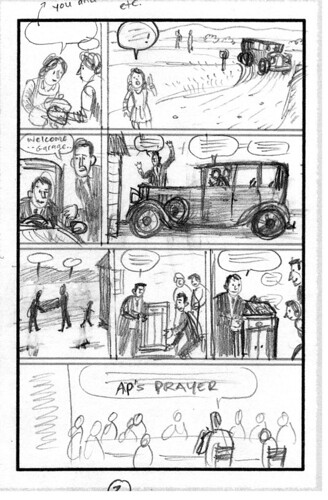
Next is the first rough thumbnail. This is a vital stage. Will the sequence work in comics form? Does the panel-to-panel flow make sense, and support the events and the characters? Frank did this first thumbnail. It won't win an art contest; it's only meant to serve the material.
(Note: The 'thumbnail' images are only about 3 inches tall. Just enough to get a sense of what will fit on the page, without getting bogged down in details.)
Next, David took this first rough thumbnail and revised it. Notice that he cuts out a panel and adds another. This was a good decision. His sketches are tighter than the first thumbnail, but still more suggestive than definitive.
(We wanted to highlight the fact that the Ralph Peer's Cadillac is large -- too large for the garage A.P. has built in anticipation of the visit. We've also added a panel to the presentation of the Orthophonic Credenza, an important gift from Peer to the Carters.)
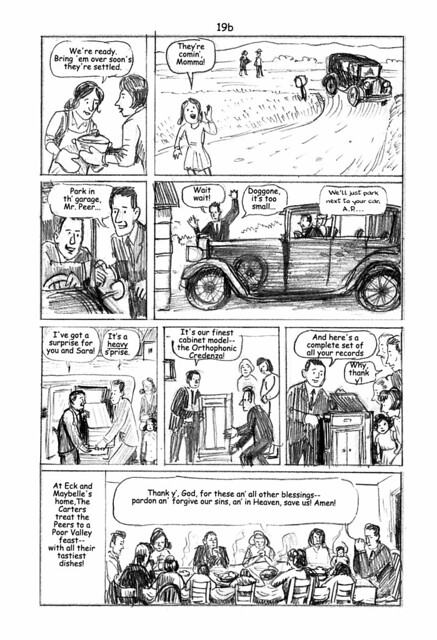
In the next iteration, (a pencil rough drawn at print size) David tightens up the staging of the panels, the body language of each character, and gives a strong sense of the settings. Frank then enters the first draft of the dialogue.
Then, it's decided that a long-shot could be made more effective as a medium shot (in panel 5). At this point, the page is ready to commit to ink on paper.
(We showed the rough draft of our book to an artist who is very experienced with this kind of material, and he advised me to draw Ralph Peer's Cadillac Limo much larger. On this page I digitally enlarged the Cadillac in every panel, and made Peer higher in the driver's seat, in panel 3. We also decided to add more family members to the table in the last panel.)
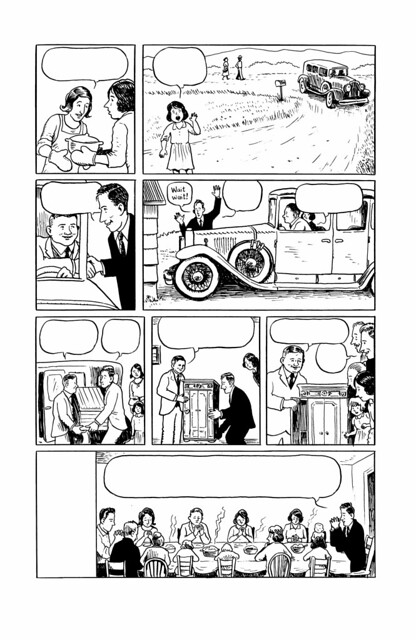
As David inks the final version, he tightens up the compositions and figures. This piece of the story really and truly comes to life.
(I should note that we had to find reference photos for the Cadillac Limo and the Orthophonic Credenza. Extra time, but worth it for historical accuracy.)
Now it's ready for Frank to color. After that, the final dialogue is written. There are some small changes from the first draft of the dialogue and narration--mostly in reducing the amount of text.
As said, this page did not undergo a major change from start to finish--just a refinement of the narrative event that its eight panels capture.
(I hope what comes across is that a great amount of care went into making every page of this book. Frank and I gave this our all.)
If anyone would like to see larger versions of the images above, they are all available on flickr.com: http://www.flickr.com/photos/dlasky/tags/dftspageevolution/
The text here, is by Frank, unless I pipe in (with blue type)...
-David
The process of creating comics is highly subjective. Some artists just put pen or pencil to paper and move forward, without a clear idea where they're going. Others out-do Alfred Hitchcock in the pre-planning stages, and create multiple images of each panel before they commit the final image to paper.
Add a writer to the mix, and their style of input also affects the creative outcome.
Every cartoonist or creative team has their own method. And a method of some kind is a must--especially when creating a long-form work. Our agent, Bob Mecoy, has called our graphic novel a "movie on paper," and some of the methodology of film-making did influence our approach.
Here is the origin of one page from our book, from rough script to thumbnails to pencil and ink to publication.
The script, at this point, is more of a guidepost of the marks we want to hit in each panel. There's no for-real dialogue--just detailed descriptions of each panel's event, mood and what each character is doing or feeling. Nothing is cast in stone here. In this case, the finished page is pretty close to the descriptions in the script.
The only piece of dialogue that stayed to the end is A.P.'s blessing for the meal, in the last panel of the page. That was a documented piece of real-life speech.
Next is the first rough thumbnail. This is a vital stage. Will the sequence work in comics form? Does the panel-to-panel flow make sense, and support the events and the characters? Frank did this first thumbnail. It won't win an art contest; it's only meant to serve the material.
(Note: The 'thumbnail' images are only about 3 inches tall. Just enough to get a sense of what will fit on the page, without getting bogged down in details.)
Next, David took this first rough thumbnail and revised it. Notice that he cuts out a panel and adds another. This was a good decision. His sketches are tighter than the first thumbnail, but still more suggestive than definitive.
(We wanted to highlight the fact that the Ralph Peer's Cadillac is large -- too large for the garage A.P. has built in anticipation of the visit. We've also added a panel to the presentation of the Orthophonic Credenza, an important gift from Peer to the Carters.)
In the next iteration, (a pencil rough drawn at print size) David tightens up the staging of the panels, the body language of each character, and gives a strong sense of the settings. Frank then enters the first draft of the dialogue.
Then, it's decided that a long-shot could be made more effective as a medium shot (in panel 5). At this point, the page is ready to commit to ink on paper.
(We showed the rough draft of our book to an artist who is very experienced with this kind of material, and he advised me to draw Ralph Peer's Cadillac Limo much larger. On this page I digitally enlarged the Cadillac in every panel, and made Peer higher in the driver's seat, in panel 3. We also decided to add more family members to the table in the last panel.)
As David inks the final version, he tightens up the compositions and figures. This piece of the story really and truly comes to life.
(I should note that we had to find reference photos for the Cadillac Limo and the Orthophonic Credenza. Extra time, but worth it for historical accuracy.)
Now it's ready for Frank to color. After that, the final dialogue is written. There are some small changes from the first draft of the dialogue and narration--mostly in reducing the amount of text.
As said, this page did not undergo a major change from start to finish--just a refinement of the narrative event that its eight panels capture.
(I hope what comes across is that a great amount of care went into making every page of this book. Frank and I gave this our all.)
If anyone would like to see larger versions of the images above, they are all available on flickr.com: http://www.flickr.com/photos/dlasky/tags/dftspageevolution/
Wednesday, August 29, 2012
Diamonds in the Rough: Sara and A.P. audition for Brunswick Records
Before the Carter Family had their breakthrough moment at the Bristol Sessions, they (or at least, Sara and A.P.) auditioned for another record label: Brunswick Records. Frank and I are excited to present a full chapter from our graphic novel which tells the story of this earlier and less successful attempt to become recording artists.
Because there is little to no documentation of the event (no one can even seem to agree what city it was in), this is our vision of what may have happened at the Brunswick Session. All we really know is that A.P. was asked to play the fiddle on record and he refused.
The year is 1925, the place is Poor Valley, Virginia, on the modest farm of Alvin Pleasant and Sara Carter...
We hope you enjoyed this chapter. Learn what happens next in the graphic novel Carter Family: Don't Forget This Song, from Abrams Comicarts this fall...
Because there is little to no documentation of the event (no one can even seem to agree what city it was in), this is our vision of what may have happened at the Brunswick Session. All we really know is that A.P. was asked to play the fiddle on record and he refused.
The year is 1925, the place is Poor Valley, Virginia, on the modest farm of Alvin Pleasant and Sara Carter...

Tuesday, August 28, 2012
A nice review
Seattle artist/journalist Henry Chamberlain of The Comics Grinder has interviewed Frank and me, and posted a kind review of "Don't Forget This Song":
http://comicsgrinder.com/2012/08/27/the-carter-family-dont-forget-this-song-review/
Thank you, Henry!
(Click to links at the bottom of the page for the video interviews.)
http://comicsgrinder.com/2012/08/27/the-carter-family-dont-forget-this-song-review/
Thank you, Henry!
(Click to links at the bottom of the page for the video interviews.)
photo by Henry Chamberlain
Thursday, August 23, 2012
The Carter Family Live in Concert!
When Frank and I planned our graphic novel, we knew we definitely wanted to attempt to recreate the experience of seeing the original Carter Family play live. Though there are some great live recordings (made on border radio), there is no film footage of Sara, Maybelle, and A.P. playing music together. There is not even a photograph of one of their concerts! So we devoted a whole chapter to showing one of their live gigs, from A.P. hanging promotional posters to Maybelle chatting with the local pickers afterwards.
Here we see some local men helping the group set up in a town's schoolhouse. The stage is wood placed over barrel drums. The lighting will be provided by coal mining lamps!
On this page, the audience has arrived, the lamps are lit, and the concert begins. You can see the full chapter, of course, when the book comes out in early October...
The background art and hatching for this chapter was inked by Sean Michael Robinson. His background inking assistance was invaluable in helping Frank and I complete the book on time. Thank you, SMR!
Here we see some local men helping the group set up in a town's schoolhouse. The stage is wood placed over barrel drums. The lighting will be provided by coal mining lamps!
On this page, the audience has arrived, the lamps are lit, and the concert begins. You can see the full chapter, of course, when the book comes out in early October...
The background art and hatching for this chapter was inked by Sean Michael Robinson. His background inking assistance was invaluable in helping Frank and I complete the book on time. Thank you, SMR!
Sunday, August 12, 2012
Two-page Spread
Frank and I wanted the story of the Carter Family to really feel like it was set in times when the Carters lived. For us, the best way to do this was to evoke old newspaper comics of the time. A favorite of ours is Frank King's "Gasoline Alley" which, besides being beautifully drawn, sometimes featured ingenius Sunday pages where the panels connect up to form a landscape. These two pages are our homage to those strips; and provide a quiet moment between A.P. and his daughter.
Subscribe to:
Posts (Atom)